HTTP API
All endpoints are GET and live under the configured base path, written <path> below
(/item with config/docker.yml, /amw with config/sample.yml). Found products and
the widget script carry Cache-Control: public, max-age=<Server.httpCache>, every other
response (errors, 429, /health, /info) carries no-store; the X-Powered-By header is
disabled. Compressible responses above 1 KB (the widget script, product JSON, Swagger UI
assets) are compressed with brotli or gzip according to the client's Accept-Encoding,
with Vary: Accept-Encoding.
| Endpoint | Purpose |
|---|---|
<path>/product |
Product data as JSON (rate limited) |
<path>/widget.js |
The embeddable widget script |
<path>/health |
Health check |
<path>/info |
Server information |
<path>/openapi.json |
OpenAPI 3 description (only when Server.swagger is true) |
<path>/docs/ |
Interactive Swagger UI (only when Server.swagger is true) |
GET <path>/product
Returns one product, looked up by ASIN or by keyword.
| Query parameter | Constraints | Description |
|---|---|---|
id |
ASIN: 10 uppercase letters or digits (^[A-Z0-9]{10}$) |
Amazon product identifier. Looked up with GetItems. |
keyword |
string, max 100 characters | Search terms. The first SearchItems result is returned. |
At least one of them is required; if both are given, id wins. Both are trimmed and an
empty value counts as absent. Control characters and < > " ' are removed from keyword
before the lookup; an id that is not an ASIN is rejected. Parameters are validated with
zod schemas (src/server/Schemas.ts), which also provide the
constraints of the OpenAPI document.
curl "https://your-site.example/item/product?id=B084DN3XVN"
curl "https://your-site.example/item/product?keyword=arduino"
200 OK
{
  "image": "https://m.media-amazon.com/images/I/....jpg",
  "title": "Product title",
  "url": "https://www.amazon.fr/dp/B084DN3XVN?tag=yourtag-21&linkCode=...",
  "brand": "Brand",
  "asin": "B084DN3XVN",
  "price": "16,39 €",
  "timestamp": 1765230898000,
  "savings": 0
}
| Field | Description |
|---|---|
image |
URL of the primary large image. |
title |
Product title. |
url |
Product page URL including your partner tag. |
brand |
Brand, or an empty string. |
asin |
ASIN of the returned product. |
price |
Price of the first offer as formatted by Amazon, or -1 when there is no offer. |
timestamp |
Time AMW fetched the product from Amazon (milliseconds since epoch). |
savings |
Discount percentage of the first offer, 0 when none. |
Errors
| Status | error |
When |
|---|---|---|
400 |
Validation Error |
id and keyword are both missing or empty (also after sanitization, e.g. ?keyword=%3C%3E), a parameter is repeated (array), id is not an ASIN or keyword is too long. |
404 |
Product Not Found |
Amazon reports the item as missing (unknown or unavailable ASIN, no search result) or returns unusable product data. |
429 |
n/a (body: Too many requests, please try again later.) |
More than Server.rateLimit requests from the same client IP within one minute. |
500 |
Internal Server Error |
Unexpected error. |
502 |
Bad Gateway |
The Amazon call failed: invalid credentials, Amazon server error, network error, malformed answer. Details are logged server-side. |
503 |
Service Unavailable |
Amazon throttled the request (your API quota is exhausted for now), or Amazon calls are suspended by the circuit breaker and no cached copy is available. A Retry-After header (Amazon's value, 60 s by default, or the remaining breaker cooldown) tells clients when to retry. |
504 |
Gateway Timeout |
Amazon did not answer in time (Amazon-side timeout, or more than 30 seconds). |
Only successful lookups are cached; errors are never stored in Redis.
JSON error bodies have the form:
{
  "error": "Validation Error",
  "message": "Missing required parameter: id or keyword",
  "timestamp": "2026-10-20T12:00:00.000Z"
}
Rate limiting
/product is limited per client IP (as resolved by
Server.trustProxy) over a fixed one-minute window. Responses
include the IETF draft-8 headers RateLimit-Policy and RateLimit; a rejected request
gets HTTP 429 with a Retry-After header (seconds). /products shares
the same counter (a batch counts as one request); the other endpoints are not rate limited.
GET <path>/products
Fetches up to 10 products by ASIN in one request: GET <path>/products?ids=B084DN3XVN,B08N5WRWNW.
The widget uses it for the cards of a page that start loading together.
ids: comma-separated ASINs (10 uppercase letters or digits), at most 10; spaces around commas and duplicates are ignored. Anything else is rejected with400 Validation Error.- The answer is always HTTP 200 (once validated) with one result per distinct ASIN, in
request order.
statusis the code/productwould have answered for that ASIN (200,404,500,502,503,504);productis present when it is200. - Uses the same Redis cache, not-found cache, stale fallback and circuit breaker as
/product; the ASINs missing from the cache are fetched with a single Amazon call. - The response carries
Cache-Control: public, max-age=…only when every result is200(no-storeotherwise), with the max-age of/productfor its oldest product, so that no product outlives the 24 h freshness limit.
{
  "results": [
    { "id": "B084DN3XVN", "status": 200, "product": { "title": "Arduino Uno R3", "...": "..." } },
    { "id": "B000000000", "status": 404 }
  ]
}
GET <path>/widget.js
Serves the minified widget (<Server.projectDir>/dist/widgets/widget.js) with
Content-Type: application/javascript. See Add widgets to your website.
GET <path>/health
{
  "status": "ok",
  "version": "5.0.0",
  "timestamp": "2026-10-20T12:00:00.000Z",
  "uptime": 3600.5,
  "redis": "connected"
}
redis is connected, disconnected or disabled. The endpoint always answers 200
while the process is up; the Docker HEALTHCHECK uses it.
GET <path>/info
{
  "name": "Amazon Modern Widgets (AMW)",
  "version": "5.0.0",
  "author": "Ludovic Toinel",
  "source": "https://github.com/ltoinel/amw",
  "endpoints": ["/item/product", "/item/widget.js", "/item/health", "/item/info"]
}
When the Swagger UI is enabled, endpoints also lists <path>/openapi.json and
<path>/docs/.
Swagger UI and OpenAPI
Set Server.swagger: true (or SERVER_SWAGGER=true) to
expose:
GET <path>/openapi.json: the OpenAPI 3 description of the endpoints above, built at startup with the configured base path, rate limit and HTTP cache values;GET <path>/docs/: Swagger UI, served from the AMW server itself (no CDN).<path>/docsredirects to<path>/docs/(301).
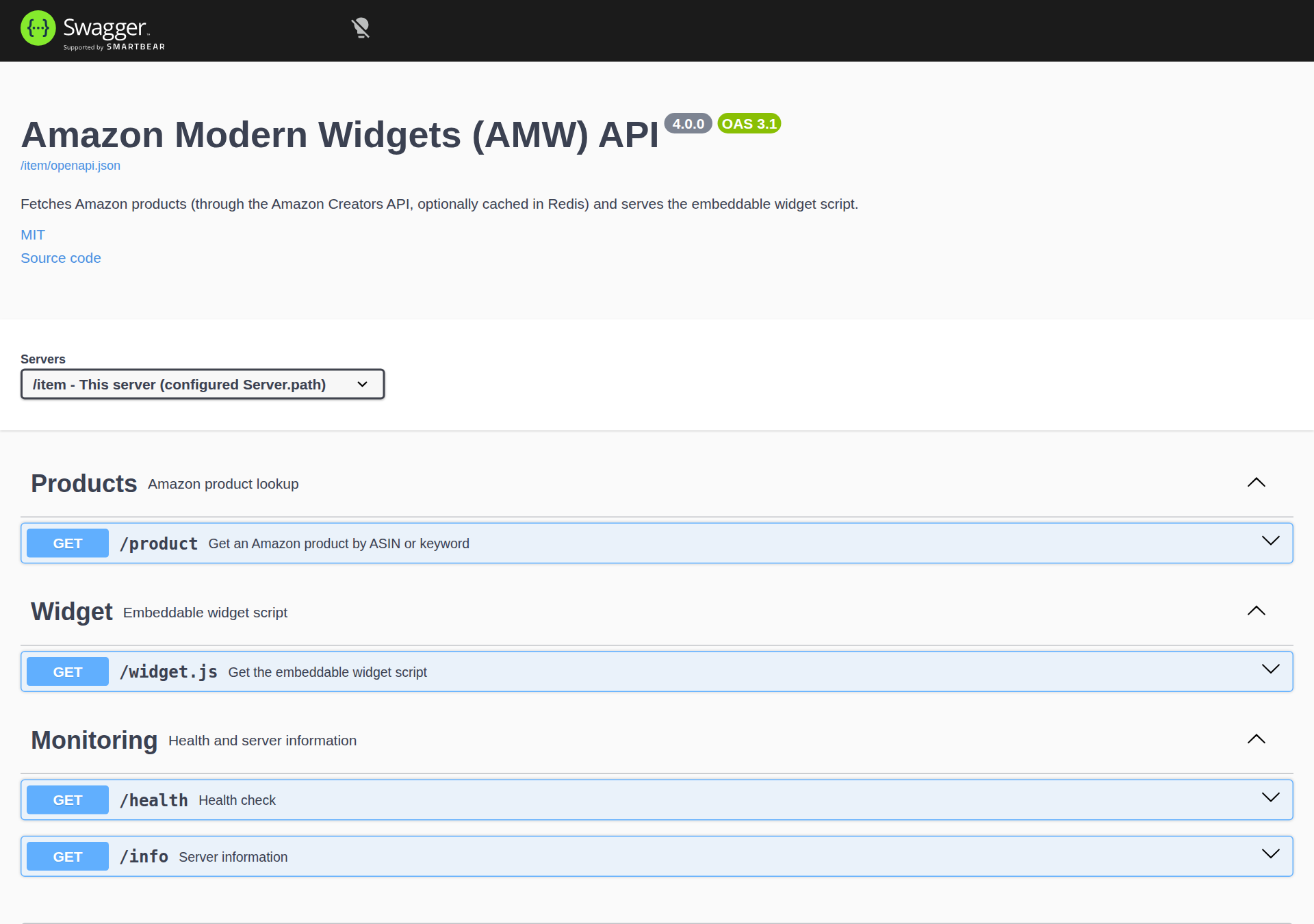
The Swagger UI is disabled by default; when disabled, its module is not even loaded. When enabled, its pages are hardened:
- a
Content-Security-Policyrestricts scripts, styles, images and API calls to the AMW origin and forbids framing (frame-ancestors 'none'); - the UI always loads
<path>/openapi.json: the?url=query parameter is ignored, so the page cannot be pointed at a third-party document; - the online validator badge is disabled, so the document is never sent to
validator.swagger.io.
"Try it out" sends real requests: /product calls count against your Amazon quota and
the rate limit like any other.
GET <path>/metrics
Prometheus metrics in the text exposition format, only when Server.metrics is true
(otherwise 404). Sent with Cache-Control: no-store. The route has no authentication:
restrict it to your Prometheus network, for example at the
reverse proxy.
| Metric | Labels | Meaning |
|---|---|---|
amw_http_requests_total, amw_http_request_duration_seconds |
method, route, status |
Requests and latency per route pattern (unmatched for unknown URLs) |
amw_amazon_request_duration_seconds |
operation (getItems, searchItems), outcome (found, not_found, error) |
Amazon Creators API latency; the _count series with outcome="error" counts failures |
amw_cache_lookups_total |
result (hit, miss, error) |
Redis product cache lookups |
amw_rate_limit_rejections_total |
route |
Requests rejected with HTTP 429 |
amw_process_*, amw_nodejs_* |
Node.js process metrics |
Example Prometheus queries: cache hit ratio
sum(rate(amw_cache_lookups_total{result="hit"}[5m])) / sum(rate(amw_cache_lookups_total[5m]));
Amazon p95 latency
histogram_quantile(0.95, sum by (le) (rate(amw_amazon_request_duration_seconds_bucket[5m]))).
Other routes
Any other path returns 404 with {"error": "Not Found", "message": "Route <url> not found", ...}.