Performance
Benchmarks
The RAPTOR engine holds all GTFS data in memory with optimized data structures, so the core round-based scan is fast (single-digit to low-tens of milliseconds). The end-to-end response time of GET /api/journeys/public_transport is higher because each request also runs the iterative diverse search (RAPTOR is re-run up to max_journeys times with pattern exclusion to produce varied alternatives) and enriches transfers via Valhalla (one walking-route call per transfer).
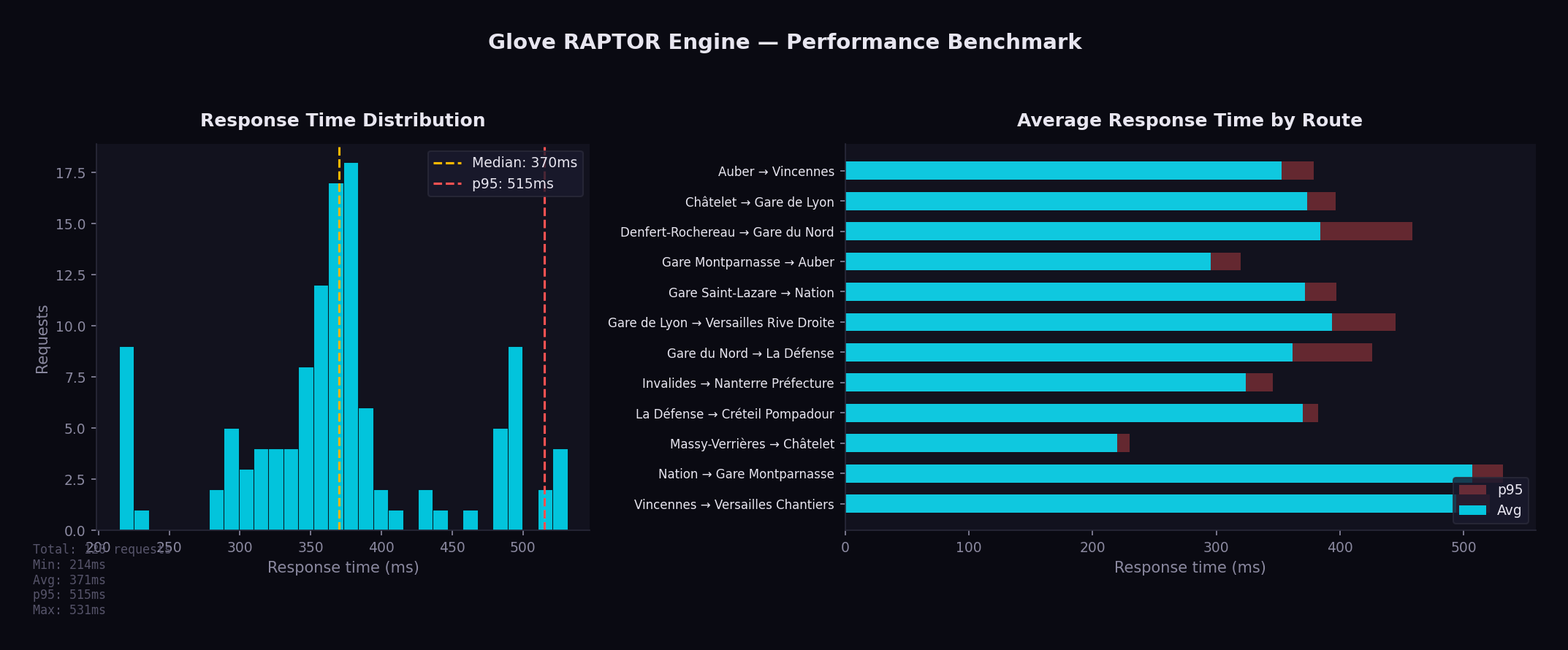
Benchmark across 12 origin/destination pairs covering Ile-de-France (10 rounds, single-threaded, weekday morning departure), with the default config.yaml (max_journeys: 5, prefer_rail: true):
| Metric | Value |
|---|---|
| Min | 270 ms |
| Avg | 1,425 ms |
| Median | 1,362 ms |
| p95 | 3,363 ms |
| Max | 4,281 ms |
These are end-to-end API times (iterative diverse search + Valhalla transfer enrichment), not the bare RAPTOR scan. The query is bounded by target + max-duration pruning (raptor_query_bounded): the scan stops relaxing stops that can no longer improve the journey to the destination within max_duration. This roughly halved suburban routes (e.g. Massy-Verrières → Châtelet). The remaining cost is dominated by the number of alternatives (max_journeys): central routes that return 5–7 distinct journeys re-run RAPTOR several times and are the slowest. Lowering max_journeys reduces response time further.
Running Benchmarks
python3 scripts/benchmark.py --rounds 10 --concurrency 1 --datetime 20260529T083000
The benchmark script:
- Sends requests to 12 representative origin/destination pairs (stop-to-stop)
- Measures response times across multiple rounds
- Prints a summary table and generates a chart (
--output, defaultdocs/benchmark.png)
Pick a --datetime that falls inside the loaded GTFS service window (otherwise no journeys are found). For high request rates, set server.rate_limit: 0 in config.yaml so the rate limiter does not reject the burst.
Key Optimizations
Binary Search in Trip Lookup
The find_earliest_trip function uses binary search (O(log n)) to find the first trip departing after a given time within a pattern, instead of linear scan.
Pre-Allocated Buffers
Label arrays and working buffers are allocated once and reused across RAPTOR rounds, eliminating per-round allocation overhead.
FxHashMap
Uses rustc-hash's FxHashMap throughout both GtfsData and RaptorData, replacing all standard library HashMap instances. FxHash is significantly faster than the default SipHash for integer and string keys.
Lock-Free Hot-Reload
ArcSwap provides atomic pointer swaps with zero contention. Readers never block, even during a reload. There is no mutex, no RwLock, and no read-side overhead.
Target + Max-Duration Pruning
raptor_query_bounded tracks an upper bound = min(departure + max_duration, best arrival at the destination) and refreshes it after each round. Relaxations (and the transfers/markings they trigger) beyond that bound are skipped, so the scan no longer expands the whole 54,000-stop network toward irrelevant or too-distant stops. This roughly halves long suburban queries while returning identical journeys.
Early Termination in Diversity Loop
The RAPTOR diversity loop (which re-runs the algorithm with pattern exclusion to find alternative journeys) terminates early when a round produces no new journeys, avoiding unnecessary iterations.
Arc<WalkLeg> Cache
Walking leg results from Valhalla are wrapped in Arc<WalkLeg> and cached, avoiding deep cloning of polyline coordinates when the same walk leg is referenced by multiple journeys.
Batch Valhalla Calls
Transfer enrichment requests to Valhalla are dispatched in parallel using futures::join_all, rather than sequentially, reducing latency for journeys with multiple transfers.
Pareto-Optimal Exploitation
All Pareto-optimal journeys from a single RAPTOR run are collected before the algorithm is re-run with pattern exclusion. This avoids redundant computation.
Cache Persistence
The RAPTOR index is serialized to disk with a fingerprint derived from the GTFS data. On restart, if the fingerprint matches, the cached index is loaded in sub-second time instead of rebuilding (10-30 seconds).
Pattern Grouping
Trips with identical stop sequences share a single pattern. For the Ile-de-France dataset this collapses ~391,000 trips into ~10,000 patterns, cutting the entities the algorithm scans by an order of magnitude.
Memory Usage
All GTFS data is held in memory. For the Ile-de-France dataset (as reported by GET /api/status and GET /api/metrics):
| Data | Approximate Size |
|---|---|
| Stops | ~53,700 entries |
| Routes | ~2,000 entries |
| Trips | ~391,000 entries |
| Stop times | ~8,370,000 entries |
| Transfers | ~202,000 entries |
| Patterns | ~10,000 groups |
| Resident memory (RSS) | ~265 MB |
| Virtual memory | ~480 MB |